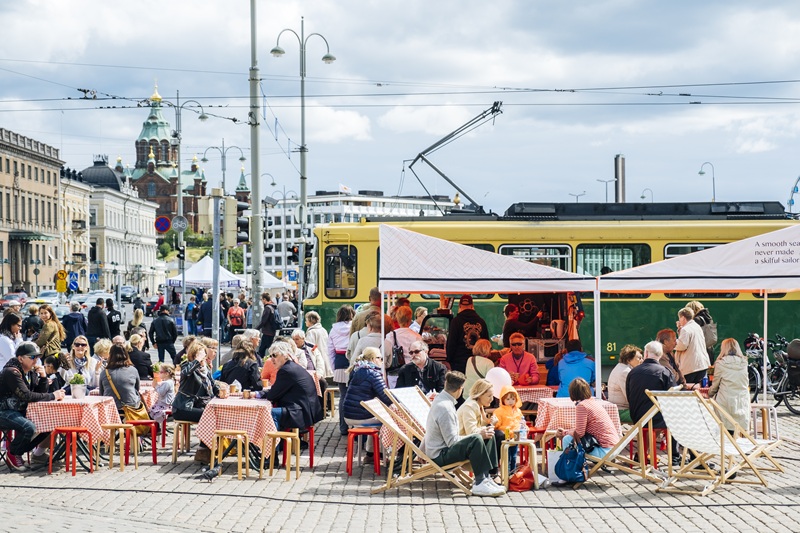
Helsinki Day, or Helsinki Päivä, is Helsinki’s official birthday celebration held on 12 June. It is basically a huge Helsinki city festival. Throughout the day, locals and visitors enjoy a free cultural programme around the clock, from crafting sessions and concerts in the park to free admission to museums and churches.
As someone who enjoys free cultural events and often travels specifically for these local opportunities, experiencing Helsinki Day was very high on my list (psssst, it is also my birthday!). So, last year I joined the festivities.
Picture Credit: Jussi Hellsten for Helsinki Partners
Helsinki City Festival: Quick Historic Overview
Helsinki was not always Finland’s capital. For centuries, that title belonged to Turku, which was Finland’s largest and most important city during the Swedish era. After Sweden lost Finland to Russia in 1809, the country became the autonomous Grand Duchy of Finland within the Russian Empire. Just a few years later, in 1812, Tsar Alexander I moved the capital from Turku to Helsinki. The decision was partly political. Turku remained closely tied to Sweden, while Helsinki, located further east and closer to St Petersburg, was seen as a better fit for the new era. It also offered a relatively blank canvas for the Tsar’s vision of a modern capital, allowing the city to be redesigned with grand neoclassical architecture and wide boulevards worthy of its new status.
As for the date itself, this one goes back much further. On 12 June 1550, King Gustav Vasa of Sweden founded Helsinki at the mouth of the Vantaa River, near what is now Vanhankaupunginkoski, or the Old Town Rapids. The city has celebrated its birthday on this date since 1959. Fortunately, the anniversary also falls at one of the best times of year. June brings the White Nights, meaning long daylight hours, milder temperatures and the promise of summer, making it the perfect occasion for Helsinki to throw a citywide birthday party.
Helsinki City Festival: Insights & Programme
Helsinki Day is not one central festival, but rather a citywide “open house”, making it a unique Helsinki city festival where people often move between neighbourhoods, parks, museums and churches rather than staying in one place.
The vibe is very low key and community focused rather than loud or commercial. That contrasts with typical European summer festivals which tend to have big stages and crowds everywhere.
As Helsinki’s official birthday celebration, this Helsinki city festival turns the whole city into an open programme of culture, music and community events. The agenda is usually filled with local community events, free admission to cultural institutions, pop up workshops, exhibitions and concerts in the parks. In 2026, a two day open air concert featuring Lewis Capaldi, Black Eyed Peas, JVG, Macklemore, Flo Rida, Haloo Helsinki!, KUUMAA will officially open the festival season.

Anyone can take part and, in many ways, the offering is similar to the European Heritage Days, except that it is condensed into a single day and held in celebration of Helsinki’s birthday. Most events are available in English, although some are conducted solely in Finnish or Swedish. Regardless of any language barrier, I encourage you to take part. Finns are very welcoming towards visitors and will make you feel welcome regardless. Even though visitors are welcome, it does not feel staged for tourism, more like the city opening its daily life and institutions for one shared moment.
All events for the Helsinki city festival are announced at the end of May, but it is worth checking the Helsinki Day programme regularly for any last minute additions or changes. Most events do not require tickets, although some activities and experiences require advance registration due to limited capacity. That said, some people (very me!) plan a full itinerary, while others just wander and stumble into events, especially in parks or cultural venues that are close together.
Some events return every year, such as the Mayor’s coffee morning, concerts at Temppeliaukio Church and free admission to the Design Museum and the Museum of Finnish Architecture.
Most events begin at around 10 or 11 am.
For 2026, the following events would interest me:
- 8:30am Mayor Coffee Morning at the Town Hall
- 10-3pm: guided tours at the opening of Hanasaari power plant
- Design & Architecture Museum
- Didrichsen Art Museum
- 1pm: free design tour at Tamminiemi House
- 4pm Helsinki goes EDM at Kaisaniemi park
- 7:30pm tour and concert at Temppeliaukio Church
I took part in the Helsinki city festival in 2025 and here is what I got up to on that special day:
Helsinki City Festival: Morning Events
My first event of the day was the official opening ceremony at City Hall, where the Mayor hosted a morning coffee reception. The event was scheduled to start at 8:30 am and, usually, the German in me would have arrived right on time. On this occasion, however, I did not want to come across as someone too keen, so I aimed for 8:45 am instead. Big mistake!
The programme mentioned that the morning coffee, complete with traditional rhubarb cake, would also feature a book giveaway and that visitors should bring a tote bag. That piece of information went totally over my head. I registered it mentally but did not think much of it. As soon as I arrived at the City Hall, people were all over the tables. Not for the free coffee and cake, but for the books!


And there were some fantastic books up for grabs. Most were brand new. Since I had arrived “late”, some of the popular architecture guides had already been snapped up, but I still managed to secure two brand new Otava publications on the history of Helsinki, an architectural guide to schools in Brussels (all Art Nouveau and entirely in French) and a Finnish language guide to Helsinki’s urban development. I had to have it as it looks super interesting. Helsinki is built across several islands and has also expanded through land reclamation over the centuries. The guide is packed with historic photographs, old development plans and data, making it a fascinating record of how the city has evolved.
Once I had secured my books, I finally grabbed a coffee and a slice of rhubarb cake before joining a guided tour of the city hall, including its impressive banquet hall and reception rooms. Visitors were allowed to explore the building and learn more about the city council’s 150th year anniversary. Staff handed out information leaflets and you can find more information online (and have it translated in English) on the 150th year City Council anniversary page.


Helsinki City Festival: Noon and Afternoon Events
The weather that day was very unpredictable and it had just started raining when I made my way to the next event. I attended a kantele concert at the Burgher’s House Museum, which was very high on my list because it combined two distinctly Finnish cultural experiences. The kantele is a traditional Finnish plucked string instrument with an enchanting sound often compared to a harp or a medieval mandolin, while the Burgher’s House is Helsinki’s oldest surviving wooden house, built in 1818.
While it poured with rain outside, the atmosphere inside the Burgher’s House was cosy and intimate. Only a handful of visitors could fit into the small lounge, making the performance feel personal. The two performers, an opera singer and a professional kantele player, sang beautiful Finnish folk songs from the 18th & 19th century. It was delightful!

Did You Know? The kantele remains one of Finland’s most popular instruments to learn, alongside the piano and flute. Its delicate, almost magical sound makes it easy to understand why it has remained such an important part of Finnish musical heritage. The Helsinki Day heritage concert was performed by the Opera Tellus collective, whose repertoire includes many traditional Finnish songs and ballads. In case you would like to explore the music further, here are their Finnish songs and lyrics.
After the performance, visitors were invited to explore the museum. The Burgher’s House consists of two separate wooden houses and a small courtyard. The interiors reflect a petite bourgeois lifestyle from the 1860s, with a kitchen and dining room in one house, and a living room in the other.
Rumour has it that the courtyard is haunted by its former owner, Alexander Wickholm. In one part of the garden there is a sitting stone which, when it was once moved, is said to have caused some upheaval and a series of supernatural events around the houses. As a result, it was eventually placed back in its original position.


Later that afternoon, I visited Kunsthalle Helsinki, an art hall showcasing contemporary art. There I saw their new exhibition, “Summer Rain”. On display was a Finnish contemporary artist who developed a programme called Buddha Orchestra, which translates paintings into music. It is based on Kandinsky’s theory that colours correspond to musical notes and that paintings can be understood as compositions. It was incredibly creative and exactly the kind of intellectual stimulation I enjoy.
The rest of the exhibits and artworks were a mixed experience. Some engaged me briefly, while others felt too contemporary for my liking and I did not fully understand or connect with them. In general, I tend to prefer paintings over art installations, photography, or sculptures.

Next on my list was a free 90 minute walking tour organised by the City Museum, and the theme was the architecture and the quarter around Senate Square. The walking tour explored not only the city structure and blocks in the area, but also Senate Square itself, the Bank of Finland and the National Archives.
The neoclassical centre of Helsinki was designed by Carl Ludvig Engel, a German architect from Berlin. He was commissioned in the early 19th century, shortly after Helsinki became the capital of the Grand Duchy of Finland, to transform the city into a representative capital, with Senate Square as its centrepiece. His work in Helsinki mainly took place from around 1816 until his death in 1840. Influences were drawn from Saint Petersburg and Berlin’s neoclassicism, where symmetry, column systems and other architectural principles inherited from classical antiquity and the Renaissance played a significant role. In the late 19 century, a smaller ensemble of public buildings, including the Bank of Finland, the House of the Estates and the National Archives of Finland, was created adjacent to Senate Square. This too reflected Renaissance ideals, but with a more patriotic character.
The walking tour was a bit of a let down, as the guide was disengaged and not very enthusiastic. She also mentioned a couple of incorrect facts, such as claiming the sea distance to Tallinn is 8 km, when in reality it is around 80 km. Overall, she was not very talkative or particularly keen to share information. Fortunately, I had a few locals in the group who shared some of their own random facts with me, so I still managed to learn a few of Senate Square’s secrets.


Helsinki City Festival: Evening Events
The finale of my Helsinki Day was meant to be the guided tour and free concert at Temppeliaukio Church. I arrived about an hour before the show started at 6:30 pm, but the queue was already very long. They only allowed 35 people inside, and entry was strictly first come, first served. Even though a few people dropped out of the line, I did not make it in; I was just on the wrong side of the cut off point, around visitor number 40.
So for Helsinki Day, the same etiquette and planning rules apply as for European Heritage Days. Make sure to secure tickets and spots for workshops as early as possible for any events that require registration, and if something is first come, first served, it is worth factoring in plenty of queuing time.

FAQs about the Helsinki City Festival
I understand this is quite a lengthy post and you may have some quick questions about whether taking part in the Helsinki city festival is worth your time. You can, of course, always come back to any section of my free travel guide and read in more detail what you’d need for your travel plans. As always, if you have questions or need help, please get in touch and I’m happy to assist.
Is it worth visiting Finland for the Helsinki City Festival?
Yes, taking part in Helsinki’s birthday celebrations is good fun. Not only is this a typical city festival, but also a mix of cultural events, including local workshops, open days and free admission to many museums and cultural centres. You can celebrate alongside locals, take part in craft sessions and experience Finnish culture up close. Plus, Helsinki Day is a free cultural event.
How easy is it to take part in the Helsinki City Festival?
Super easy. The Helsinki Day celebrations are open to both visitors and locals. You do need some planning in advance and should check the official programme before your visit. This ensures you know exactly which events are on offer and at what times, which ones interest you, and which require you to secure a spot in advance.

What’s on offer during Helsinki Day?
During Helsinki’s official birthday celebrations, there are several events happening across the city centre and its neighbourhoods. There are organised community events such as walks, workshops or nature hikes, as well as concerts, free admission to cultural institutions and museums, and even watersports. The programme is not only friendly for solo travellers, culture nerds and families, but also makes it easy to take part whether you are a visitor or a local.
What makes the Helsinki City Festival so special?
The range of venues is a big part of what makes this day so versatile and interesting. The City Hall, museums, churches, courtyards, parks and even small historic houses take part and bring you to places that you may have never visited otherwise. This variety makes the Helsinki Day experience feel like a “city sampler” rather than a concentration on a single festival site.
Another key point is the contrast between quality and simplicity. Many events are very simple in concept, like a coffee morning, a short concert, a local get together or a guided walk, but the access to normally closed or paid spaces is what makes it extra special.
Helsinki Day also has a “choose your own adventure” feel. There is no single programme that you have to follow, so the experience depends entirely on what you pick, what you queue for and what you stumble into.
Thank you so much for reading. If you enjoyed my guide on how to take part in the Helsinki city festival and would like to support my blog & research, you can do so via Buy Me a Coffee.
Till next time,
Carolin
Want to read more content from Finland? You may also like:
- Brand New Coffee Guide to Helsinki Cafes & Finnish Coffee Culture
- Is Helsinki Worth Visiting: 7 Solid Reasons & Travel Advice
- Everything You Need to Know about direct Berlin to Helsinki Flights
- 3 Week Itinerary For An Epic Baltics Tour & Finland Trip
- FREE Guide: Tampere in Winter. Activities and Travel Tips


4 Comments
Lyn (aka Jazz)
16 June 2026 at 1:53 amWhat a wonderful event. I can see why you would want to return for the 2026 festival. I love the idea of the Mayor’s Coffee with free books. I can see why people would first rush for the books rather than the coffee & cake! I
would absolutely want to experience the Buddha Orchestra exhibit. I have always been a fan of Kandinsky, as he and I share the same weird neurological condition of synesthesia, where we actually “see” and “feel” music.
Emma
17 June 2026 at 12:04 amI feel like a city’s birthday party in most other cities would be a loud concert or unrelated event so the fact this one is not only a bit understated but highlighting local culture and history is so nice. One of the reasons I continue to like Finland. Plus free books… you can’t go wrong. Shame you didn’t make the cut for the one event but I like the sound of the traditional musical instrument concert. What a great experience
Alison
19 June 2026 at 3:01 pmWhat a great event. I love that there’s so much to see and do throughout the day so you can pick and choose exactly what suits you. I’d be there early for the free books for sure! Definitely an interesting way to celebrate Helsinki – and your birthday too!
Mitch
21 June 2026 at 2:01 pmHappy birthday, Helskinki! And what an amazing way to celebrate. I love the idea of the city being ‘open house’ to all. From the coffee, rhubarb cake and free books at the start of the day to the concerts, art and museums. The Buddha Orchestra sounds amazing! Shame about the walking tour guide (although great to get some insights from the locals) and how annoying that you didn’t quite get in to see the evening concert. We need to return to Helsinki as it’s been about 25 years since we last explored it, and I think we should try to time our visit to include the 12th June!